

Our Attention Generates Relationship
part 2 in a 6-part series on the formula of revolution

There is a version of American identity built entirely around looking inward: the mythology of the self-made individual, the frontier fantasy of pulling up stakes and starting over somewhere no one knows your name, the political rhetoric that frames every extension of care to a neighbor as a threat to your own survival. Close the door. Protect what’s yours. The table only fits so many people.
That story is a lie. It has always been a lie. The actual history of human survival, the parts that don’t get taught in the curricula that lawmakers are currently gutting, is a history of people choosing to widen their understanding of who their neighbors are — over and over, across centuries and continents — because the communities that endured were the ones that learned to see strangers as kin. We are living through a moment when the contraction impulse is being written into law and enforced at gunpoint and then celebrated on the evening news. This is not our history, and it does not have to be our future.
🗺️ The Longest Road to Someone Else’s Door
In March 1847, a group of Choctaw people gathered in Skullyville, Oklahoma, to hear news from the other side of the Atlantic. They had been in Oklahoma for less than two decades — the U.S. government had forced them off their ancestral lands in Mississippi, Louisiana, and Alabama under the Indian Removal Act, marching them hundreds of miles to a territory they had never seen, and roughly a quarter of those who walked the Trail of Tears did not survive it, dead of starvation, exposure, and disease. They were still rebuilding their government and their community from that rupture. They were asked to help strangers in Ireland, where the potato famine was killing people by the thousands. They had very little. They gave anyway.
The Choctaw of Skullyville raised $170, worth thousands of dollars in today’s money. The Choctaw of Doaksville raised another $150. The Cherokee Nation gave $200 more. According to the Choctaw Nation of Oklahoma, this gift arrived in Ireland at the height of what the Irish call “Black 47,” the worst year of the famine, when close to a million people were dying of starvation. A people who had survived their own government-engineered catastrophe looked across an ocean at another catastrophe and recognized it not as an abstraction, not as a cause, but as something they understood from the inside, the specific texture of being abandoned by the powerful and kept alive only by the hands of others.

That act of attention generated a relationship that has now lasted nearly two centuries. In 2020, when the Navajo Nation and the Hopi reservation were among the communities hardest hit by COVID-19, the Irish raised nearly $2 million in relief donations, crediting the Choctaw gift of 1847 as the reason. Irish President Mary Robinson, visiting the Choctaw Nation in 1995, called it completing the circle. Genuine attention across difference generates relationship that does not expire, does not require the original actors to still be alive, and compounds in ways the people who started it never imagined.
🔒 Who Counts
The question is never simply whether suffering exists. It is always whose suffering counts, whose face we allow ourselves to see.
Every exclusionary political project in history has depended on the same mechanism: convincing people that the range of human concern is appropriately small, that the right group to care about has already been identified, and that extending care beyond that group is weakness or betrayal. The Choctaw were removed from their lands partly on the theory that they were not fully human in the way that mattered to the architects of American expansion. The Irish who flooded into U.S. cities after the famine were met with political cartoons depicting them as subhuman, signs reading “No Irish Need Apply,” and the widespread insistence that they were a threat to the existing social order. The workers who built this country’s railroads and cities were paid starvation wages in part because the people setting those wages had decided, successfully, not to see them. The names change. The targets change. The mechanism is always the same: shrink the range of concern, make the excluded group into something less than human, and watch as the people inside agree, because they are frightened, because they are told it protects them, because it is easier than reckoning with what it means to draw a line around the people who deserve to survive.
In Minnesota right now, that mechanism is operating at full institutional scale. The Trump administration launched what it called Operation Metro Surge beginning in December, sending thousands of ICE and Border Patrol agents into the Twin Cities in what DHS called the largest immigration enforcement operation in the country’s history, and it is not over.
ICE simply shifted tactics after the announcement, moving into suburbs including Coon Rapids, Eden Prairie, and Columbia Heights, using drones, plain clothes, and door-to-door canvassing, while Hennepin County Attorney Mary Moriarty told reporters that ICE “continues to terrorize“ community members. A federal judge found “compelling and troubling” evidence of racial profiling by federal agents, stopped only by his refusal to order a halt while the lawsuit continues. Andrea Pedro-Francisco, a 23-year-old woman from Burnsville, was arrested on her way to work in February and shipped to a Texas detention facility one week before scheduled surgery to remove an ovarian cyst that has since grown to nearly the size of a tennis ball and is now at risk of rupturing; she is still there, as of this writing, while Congressional offices trying to reach her have been bounced by DHS with government-shutdown out-of-office messages.
The economic wreckage is only beginning to be counted. The city of Minneapolis estimated $203 million in economic damage in the operation’s first month alone. Researchers at North Star Policy Action and the W.E. Upjohn Institute found that the surge reduced the Twin Cities workforce by 2.8 percent, total hours worked by nearly 2 percent, and the number of open business locations by 1.7 percent, amounting to between $106 million and $143 million in lost wages. A United Way helpline saw a 59 percent spike in calls for housing assistance compared to last year. Families are receiving eviction notices. House Republicans voted down $50 million in emergency rental assistance for those same families. The people who caused the crisis are blocking the repair.
At the Minnesota House, Representative Isaac Schultz introduced legislation to strip undocumented students of state financial aid eligibility, explaining that taxpayer funds should not go to people who have broken the law — 617 students who received Dream Act aid in the last fiscal year, human beings with names and futures, reduced to a budget line to be eliminated.
The same logic is running globally. PEPFAR — the U.S. President’s Emergency Plan for AIDS Relief — was created by George W. Bush in 2003, celebrated by Republicans for two decades as proof that American generosity could save lives across borders, and credited with keeping more than 21 million people alive on antiretroviral treatment in over 50 countries. The Trump administration has gutted it. And now, according to a State Department memo cited by the New York Times, the administration is threatening to withhold $115 million in HIV medications from the 1.3 million Zambians who depend on PEPFAR to survive — using their lives as leverage to force Zambia to hand over access to its critical mineral wealth. The memo’s language is unambiguous: “We will only secure our priorities by demonstrating willingness to publicly take support away from Zambia on a massive scale.” A Republican program built on the idea that American care could extend across oceans is now a hostage in a minerals negotiation.
In Cuba, meanwhile, the administration’s oil blockade — triggered after U.S. forces ousted Venezuelan President Maduro and cut off Venezuelan oil to the island — has pushed the country toward what the United Nations has warned could be a humanitarian collapse. Hospitals have canceled all but emergency surgeries, ambulances are running out of fuel, and a mother quoted by The Nation said, “My little girl has asthma. There is no medicine.” The U.S. government’s position is that this is acceptable pressure toward regime change. Eleven million people are the cost of that calculation.
🧭 What Paying Attention Actually Does
The formula at the center of this series, we choose to pay attention; our attention generates relationship, is not describing a feeling. It is describing a practice, and a demanding one.
There is a reason the Trump administration is doing all of this at once — the raids, the blockade, the medication hostage, the gutted curricula, the defunded programs — and it is not only cruelty, though it is that. It is also strategy. Social psychologists have documented, across hundreds of studies, that humans, under conditions of threat and perceived scarcity, instinctively pull toward their most immediate in-group: family, tribe, people who look and sound like them. Oxytocin, the bonding hormone, biases us toward those we perceive as similar, promoting in-group cooperation while increasing wariness of outsiders. Realistic Group Conflict Theory, developed by social psychologist Muzafer Sherif, shows that the perception of scarce resources — even manufactured scarcity, even scarcity that doesn't actually exist — reliably increases hostility toward outsiders. An administration that generates constant threat, strips resources, and narrows the frame of who counts as "us" is not just being cruel. It is engineering the neurological conditions that make people abandon their neighbors.
But that reflex is not a sentence. The in-group favoritism research also shows that the effect is strongest when people define their in-group narrowly — and weakest, even reversible, when that definition expands. Paying attention to someone is the mechanism by which they move from outside the circle to inside it. This is not ideology. It is how the brain actually works. In 1847, the Choctaw did not overcome human nature to give what they gave. They extended it, letting their understanding of “their people” grow large enough to include strangers dying on the other side of the Atlantic, because they had paid enough attention to recognize what those strangers were going through.
Paying attention to someone means orienting yourself toward them rather than toward your own reflection in their suffering. It is the opposite of self-centering. Nearly every spiritual and ethical tradition that has ever existed has a name for the love that extends beyond your own family and community — agape, tzedakah, metta, ubuntu, zakat — because every tradition that has survived long enough to pass itself down has understood that a community drawn too small eventually collapses inward. The practiced choice to see the full humanity of people outside your own immediate circle, and to treat that humanity as a claim on you, is a human idea. To believe, in the most practical and actionable sense, that everyone is your neighbor.
The Sahan Journal reported that during the height of Operation Metro Surge, foot traffic at food shelves dropped between 50 and 80 percent, not because people didn’t need food, but because leaving the house felt too dangerous. The mutual aid response that filled that gap was staggering: food deliveries to 60 families a week at Joyce Uptown Food Shelf alone, a Second Harvest Heartland worker who was herself detained a few blocks from the food bank’s warehouse, and volunteers who came anyway. “There are a lot of folks who really would have been in serious trouble if people weren’t willing to do that,” Second Harvest’s Angelica Klebsch told Sahan Journal.
🌱 The Long Record
When the Bracero Program brought hundreds of thousands of Mexican agricultural workers to the United States between 1942 and 1964, it did so explicitly to extract their labor while denying them the protections available to other workers, a boundary drawn precisely enough to capture the benefit of their presence while refusing the obligations that presence should have generated. The farm workers who organized under Dolores Huerta and the United Farm Workers in the 1960s and 70s were demanding, at the most basic level, to be seen. To have their suffering registered as real, their labor acknowledged as something other than a resource to be used and discarded. And, the grape and lettuce boycotts worked, in part, because enough people outside the immediate circle of farmworkers chose to turn their attention outward toward them.
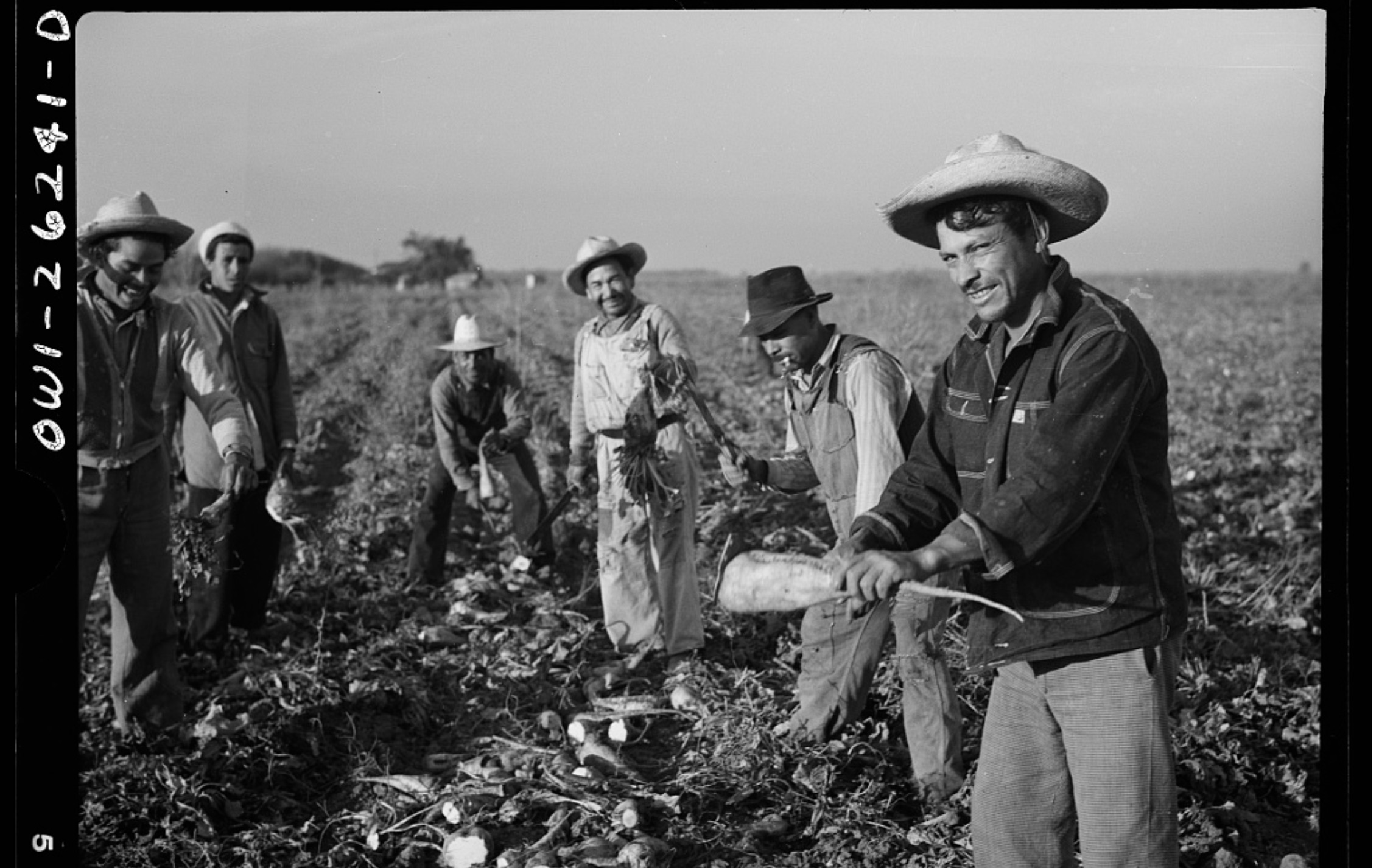
The Scandinavian and Eastern European immigrants who built communities across Minnesota in the late 19th and early 20th centuries were themselves objects of suspicion, described as racially undesirable, associated with radical politics, warned that they were changing the character of the country with the same language and the same logic of cultural contamination being used today. They stayed. They built. Some of their descendants are the people now delivering groceries to families sheltering from ICE. Some of their descendants are the ones cheering the raids.
Contraction never wins permanently. People find their way through it, or the people inside choose to open it wider, or both. That generosity given in the worst of circumstances creates a debt that doesn’t expire, a relationship that doesn’t end, a form of attention that outlasts the people who started it.
🏡 Closer to Home
In Becker County and across the 2B district, we are not insulated from what is happening in the Twin Cities. The same rhetoric circulates here. The same political project that stripped undocumented students of financial aid eligibility makes decisions that land in our schools, our local economies, our neighbors’ lives — and the family whose breadwinner has been detained is not an abstract political issue but a grocery problem, a rent problem, a childcare problem, something that can be met with a phone call and a casserole and a volunteer shift. Local governance is where the boundary of who counts gets drawn, school board meeting by school board meeting, ordinance by ordinance. “The table only fits so many.” That has always been and continues to be a lie told by people who benefit from a smaller table.
Mutual aid organizers in the Twin Cities have said clearly that donations are slowing, but the need is not. The families affected by Operation Metro Surge are still there, still working through the economic wreckage, still navigating a system that targeted them, and the organizations doing that work — MIRAC, COPAL, the Immigrant Law Center of Minnesota, food shelves, and mutual aid networks across the state — are where attention becomes relationship becomes obligation becomes action.
🔗 Acts of Interdependence
Know who in your community needs help. Connect with your local mutual aid network. If you’re in the 2B district, reach out to me for resources and connections at emilythabesformn.com.
Support MIRAC (miracmn.com) and COPAL MN (copalmn.org), two organizations working directly with immigrant communities in Minnesota.
Donate to the Immigrant Law Center of Minnesota (ilcm.org), which is providing free immigration legal services through March 2026 and beyond.
Give to Second Harvest Heartland or your local food shelf — not as a one-time surge response, but as a sustained commitment. The need does not end when the news cycle moves on.
Call your state legislators. HF1323, the bill stripping undocumented students of financial aid, passed the committee on March 10. Let your representative know that 617 students are not a budget abstraction — it is 617 people whose futures are worth defending.
Use 5 Calls (5calls.org) to contact Congressman Pete Stauber (MN-08) and tell him that immigration enforcement that kills U.S. citizens, detains legal residents without probable cause, and terrorizes communities is not a policy you will vote for.