

Local MN Reps Signed Their Names to a Lie
but we are paying attention, and I am doing something about it - so can you

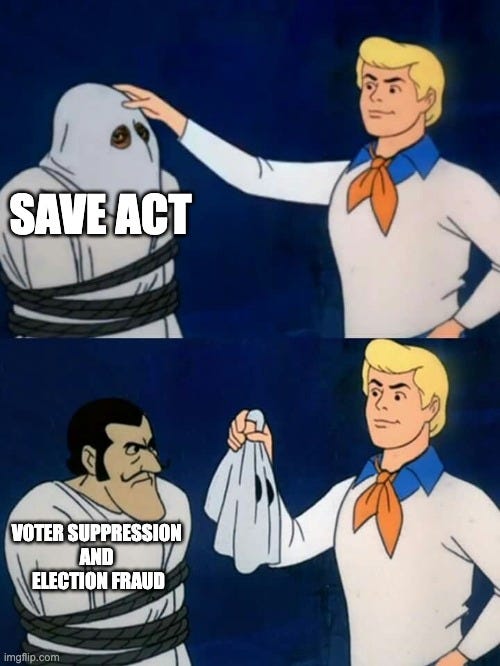
On February 27, 2026, a group of Minnesota state legislators sent a letter to U.S. Senate Majority Leader John Thune urging him to pass the Safeguard American Voter Eligibility Act — the SAVE America Act — and to do whatever it takes to break Democratic opposition, up to and including forcing a talking filibuster. The letter invokes “astounding fraud problems in Minnesota stemming from systemic failures and inadequate oversight.” It calls the SAVE America Act a “vital piece of legislation” whose passage is essential to protect democracy itself.
Representatives Matt Bliss (House District 2B), Bidal Duran (House District 2A), and Senator Steve Green (02) signed it.
Every “factual” premise in that letter is wrong.


🤷🏻♂️ The SAVE Act makes it harder for EVERYONE to vote. Except CIS White Men.
The SAVE America Act would require every American — not just new registrants, but anyone who moves, changes their name, or switches party affiliation — to appear in person at an election office and present original documentary proof of citizenship. For most people, that means a passport or a birth certificate. To be clear:
A driver’s license won’t do it.
A REAL ID won’t do it.
A military ID, without accompanying documentation, won’t do it.
A tribal ID, without accompanying documentation, won’t do it.
According to the Brennan Center for Justice, over 21 million voting-eligible Americans do not have ready access to a passport or birth certificate. The Center for American Progress documents that approximately 84 percent of women who marry change their surname — meaning as many as 69 million American women have a birth certificate that no longer matches their legal name and could not use it to prove citizenship under this law. The bill would also eliminate online voter registration, end mail-in registration, and dismantle voter registration drives that have served rural and elderly communities for decades.
The Campaign Legal Center notes that election officials who register someone who fails to present the required documentation could face up to five years in federal prison — even if that person is a citizen. Under the SAVE Act, every state would also be required to submit its full voter registration list to the Department of Homeland Security, with no restrictions on what the federal government can do with that data once it receives it.
This is not election security. It is voter suppression with a paper trail.
🗳️ There is no voter fraud in Minnesota.
The letter Green, Bliss, and Duran signed cites “recently revealed, astounding, fraud problems in Minnesota stemming from systemic failures.” It offers no specifics, because there are none.
A University of St. Thomas School of Law study conducted a comprehensive search of federal and state criminal prosecution records, legal databases, voter registration audits, think-tank studies, press accounts, national crime databases, immigration records, and jury duty registration processes — and found only three state convictions for unlawful voting or unlawful registration by noncitizens in Minnesota between 2015 and 2024, during which time 13,403,668 ballots were cast.
Three.
The Bipartisan Policy Center examined Utah’s statewide citizenship review, which audited over 2 million registered voters and found exactly 1 confirmed noncitizen registration and 0 instances of noncitizen voting. Democracy Docket reports that in the 2024 general election, less than 0.6 percent of votes cast used Minnesota’s vouching process — and about 71 percent of those were from people already registered who had simply moved without updating their address. The vouching system that Republicans have characterized as an open invitation to fraud is most commonly used in senior living facilities by elderly residents who no longer drive and haven’t updated their licenses.
When actual fraud attempts have occurred in Minnesota, the system caught them. In 2025, two people were charged with conspiracy to engage in voter registration fraud. Minnesota Secretary of State Steve Simon’s statement at the time was unambiguous: “These charges prove that our systems work.” No fraudulent ballots were cast. Local election officials identified the inconsistencies, reported them to law enforcement, and the prosecutions followed. That is a functioning system.
The fraud crisis the letter invokes does not exist in Minnesota’s voting rolls. It exists in Heritage Foundation databases and Fox News segments, laundered into official state letterhead and signed with your representatives’ names.
👥 The SAVE Act Negatively Impacts Rural Voters
The letter’s authors frame the SAVE Act as protecting “the prerogative of American citizens.” Let’s be direct about which citizens they’re willing to sacrifice.
Kansas, one of the few states that already requires documentary proof of citizenship to register, offers a preview. Before the requirement took effect, noncitizen registration in Kansas was approximately 0.002 percent of registered voters. After it took effect, according to the Bipartisan Policy Center, roughly 31,000 eligible citizens (12% of all applicants) were blocked from registering. The law stopped far more citizens from voting than noncitizens.
Now take a look at who actually lives in Districts 2A and 2B.
🏡 District 2B: Becker, Beltrami, Cass, Clearwater, Hubbard, Itasca, and Mahnomen Counties
This is deep rural north-central Minnesota, served by Matt Bliss — cities like Bagley, Blackduck, Cass Lake, Deer River, Mahnomen, and Walker. The people most likely to be disenfranchised by the SAVE Act aren’t abstractions. They are his constituents.
Elderly residents: Itasca County has a median age of 46.9, among the highest in the state. Cass and Hubbard counties are similarly aged. The Minnesota State Demographic Center finds that 1 in 3 Minnesotans over 65 reports a disability, and that the vouching system Bliss just urged Congress to eliminate is used most heavily in the senior care facilities that serve this population. Elderly residents who no longer drive, who have moved into assisted living, and who haven’t updated their licenses in years would be required to produce original documentation and appear in person at an election office to maintain a registration they already hold.
Residents with disabilities: Clearwater and Cass counties have disability prevalence rates of 16 percent or higher, among the highest in the state, according to the Minnesota State Demographic Center. Across 2B’s counties, disability rates run consistently above the statewide average of roughly 11 percent. The SAVE Act eliminates mail registration and requires an in-person appearance. This is clearly a direct barrier for people with ambulatory, cognitive, or independent living disabilities.
Women with changed names: An estimated 84 percent of married women change their surnames, according to the Center for American Progress. In these counties, a substantial majority of women who are or have been married may have birth certificates that no longer match their legal names and could not use them as documentation of citizenship. They would need a passport. In a district where median household incomes run $60,000 to $67,000, and the nearest passport acceptance facility may be an hour’s drive away, passport ownership skews low.
Leech Lake Band of Ojibwe and White Earth Nation members: The Leech Lake Band is headquartered in Cass Lake, inside District 2B. White Earth Nation members are concentrated in Mahnomen County, also part of 2B. According to Data USA's Beltrami County profile, the county is 18.9 percent American Indian. Tribal IDs are technically acceptable under the SAVE Act — but only when combined with additional federal documentation that many members do not have readily available. In January 2026, as ICE moved north through Minnesota, the Cass County Sheriff and Leech Lake Tribal Police issued a joint statement after a Leech Lake tribal member was apprehended by federal agents in Walker. These are communities being racially profiled by the same federal government that Bliss just asked to receive Minnesota’s complete voter registration database — with no restrictions on its use.
Mahnomen County has the highest Medicaid enrollment rate in Minnesota at 55 percent, according to the Minnesota Reformer. Beltrami County is at 38 percent. These are the people whose healthcare the federal government is currently holding hostage. On February 25, 2026 — two days before this letter was sent — the Trump administration withheld over $250 million in Medicaid payments to Minnesota, citing fraud.
That Medicaid freeze hits Bliss’s constituents harder than almost any other district in the state. He responded by signing a letter asking Congress to make it harder for them to vote.
🌿 District 2A: Beltrami, Clearwater, and Lake of the Woods Counties
Bidal Duran represents Bemidji and the surrounding region — parts of Beltrami and Clearwater counties and all of Lake of the Woods County. The same burdens apply here: elderly voters in care facilities, married women with mismatched documents, disabled residents who cannot travel to government offices with original paperwork, and working people who cannot take time off to appear in person.
But there is something specific to say about Duran’s district and what he signed.
Red Lake Nation is largely within the political boundaries of Beltrami County and in Duran’s district. In January 2026, as ICE moved north, Red Lake Tribal Chairman Darrell Seki Sr. sat at his desk looking at a federal funding freeze notice from the Trump administration. He called a special tribal council meeting. Members lined up down the hallway of the tribal government center to get tribal IDs, waiving the usual $20 fee because they feared being stopped by federal agents and unable to prove they were citizens of a sovereign nation whose members have been citizens of the United States since 1924. The tribal council passed a unanimous resolution barring ICE from entering Red Lake lands without a court order. Native News Online reported that a Red Lake Nation descendant and U.S. citizen was detained by ICE agents in a suburban Minneapolis parking lot in January and was initially not allowed to show proof of citizenship at the time of his arrest.
Seki told the Star Tribune: “In his first term, he targeted Native American tribes, and we already expected it after he won. We already knew what was going to happen, and it’s happened.”
Duran attended the Red Lake State of the Band Address on February 20, 2026. Seven days later, he signed a letter asking the United States Senate to make it harder for Red Lake Nation members to vote.
The Bemidji Pioneer reported that Duran was present in the room when tribal leadership described ICE moving north, federal funding being frozen, and a community steeling itself against a government that has spent two centuries trying to erase it. He was there. He heard it. Then he went back to St. Paul and signed the letter anyway.
📍 These Men Do NOT Represent The Interests of Voters of Our Community. Full Stop.
The SAVE America Act passed the House on February 11, 2026, by a vote of 218 to 213. Senate Majority Leader Thune acknowledged on February 25 that there is no clear path to passage, and the bill may not become law this cycle.
But treating this as a dead-end legislative fight misses what the law is actually designed to do. The SAVE America Act is not only a voter suppression tool. It is a mechanism for manufacturing chaos in the 2026 midterm elections. The chaos is the point. The National Association of Counties, which represents the local officials responsible for running elections, warned before the House vote that the bill would impose new, unfunded duties and increase legal exposure for election administrators without providing the resources to implement its mandates. There are more than 10,000 local election offices across the country. The law’s requirements take effect immediately, with no grace period and no funding, meaning officials would be required to build entirely new verification procedures from scratch, on their own budgets, in the months before the midterms. The League of Women Voters of Ohio put a number to it: implementing the law would require billions of dollars for training, updated forms, and public education campaigns. The bill allocates zero dollars to pay for any of it.
Minnesota Secretary of State Steve Simon said it plainly. “This is bad for voters, but this will be a nightmare for election administrators,” he told Votebeat. And under this law, administrators who make an honest mistake, registering an eligible American citizen while failing to collect the right paperwork, face civil and criminal penalties. The practical effect is predictable: officials who cannot absorb the legal risk become more restrictive, and more eligible citizens get turned away. That is not a bug. It is the design.
This is the same playbook Trump used in 2020: manufacture conditions for contested outcomes, sow enough confusion that any result can be challenged. The letter Bliss and Duran signed asked John Thune to make that happen for the 2026 midterms. They knew what they were signing. They want to continue sitting comfortably.
But the letter is not only about electoral strategy. It is about what your representatives believe about the people they serve, and what they are willing to do to them. These are communities under active federal assault: Medicaid withheld, tribal members racially profiled, and ICE moving north through the lakes region. Bliss and Duran did not write letters to Congress about any of that. They wrote a letter asking Congress to make it harder for their own constituents to vote, using the language of fraud that has been repeatedly, conclusively, and specifically debunked in Minnesota.
The people most likely to be blocked from the polls are not immigrants. They are the elders in Cass Lake nursing homes whose driver’s licenses have expired. They are the married women across Beltrami County whose birth certificates say a name they stopped using thirty years ago. They are the Leech Lake band members in Walker who watched federal agents take one of their own and had to issue a joint statement just to reassure people that local law enforcement was not coordinating with ICE. They are the Red Lake Nation members who stood in line to get tribal IDs because the federal government had made them afraid to leave the house without proof of who they are, and whose representative sat in that room, heard all of it, and signed the letter anyway.
This deserves to be on the record and deserves a response. It is one grievance in a long line of grievances against leaders whose representation has been, at best, lackluster, and at worst, a deliberate erosion of the democratic fabric that holds these communities together. Communities for which they hold charge and fail at every turn. For shame.
✊ Acts of Interdependence
Contact your representatives directly. Rep. Matt Bliss (District 2B) can be reached at (651) 296-5516 or rep.matt.bliss@house.mn.gov. Rep. Bidal Duran represents District 2A and can be reached through the Minnesota Legislature’s contact page. Tell them you saw the letter. Tell them what you think.
Contact Senator Thune’s office at (202) 224-2321 or via thune.senate.gov and urge him to let the SAVE Act die in the Senate.
Verify your voter registration now. Keep your current information accurate at mnvotes.sos.mn.gov. If the SAVE Act does become law, those already registered face new requirements only when they update — so current, accurate registration matters.
Support voter protection work in Minnesota. Democracy Docket (democracydocket.com) and MIRAC (miracmn.com) are actively monitoring voter suppression efforts in the state.
Share this piece. The letter Bliss and Duran signed was written in your name, on official state letterhead. People in Districts 2A and 2B deserve to know it exists.
Vote them out. Both seats are up in 2026, and
I am running against Matt Bliss in District 2B.
If this letter motivates you to action, your passion is useful: knock on doors, call folks in our districts on our behalf, show up on primary day, and tell everyone you know. These are not inherently safe seats. They are seats held by people who have counted on low turnout and no opposition. That ends now. Campaign details to follow soon.